


PM-UDAY Scheme
Syllabus: GS2/Governance
In News
- Recently Delhi CM has sought ₹100 crore as a first phase central government financial assistance to implement the revised Pradhan Mantri Unauthorised Colonies in Delhi Awas Adhikar Yojana (PM-UDAY) in the national capital.
The Pradhan Mantri –Unauthorised Colonies in Delhi Awas Adhikar Yojana (PM-UDAY)
- It was launched on 29 October 2019 under the NCT of Delhi (Recognition of Property Rights of Residents in Unauthorised Colonies) Regulations, 2019 .
- The DDA has an online portal for issuance of Conveyance Deeds (for government land) and Authorisation Slips (for private land). As at 31 March 2026, about 40,000 documents have been issued.
- Certificates of Regularisation and provision of civic infrastructure would be issued by the MCD and local bodies.
- It aims to provide ownership, transfer and mortgage rights to the residents of eligible unauthorised colonies in Delhi, on the basis of documents like General Power of Attorney (GPA), Agreement to Sell, payment receipts and possession documents.
- It does not cover colonies in prohibited areas such as forests, protected monuments, Yamuna floodplains, road rights of way, ridge areas and 69 affluent unauthorised colonies.
Source :HT
EU and 14 Countries Reaffirm Ruling on South China Sea
Syllabus: GS1/ Geography, GS2/ IR
Context
- The US, the UK and other Western and Asian countries reasserted that China’s expansive claims in the South China Sea are illegal based on a 2016 arbitration ruling.
South China Sea
- It is a marginal sea of the Western Pacific Ocean.
- It is located between southern China, Taiwan, the Philippines, Indonesia, Vietnam, Thailand, Cambodia and Malaysia.
- It is a crucial maritime gateway and junction for shipping between the Pacific and Indian Oceans.
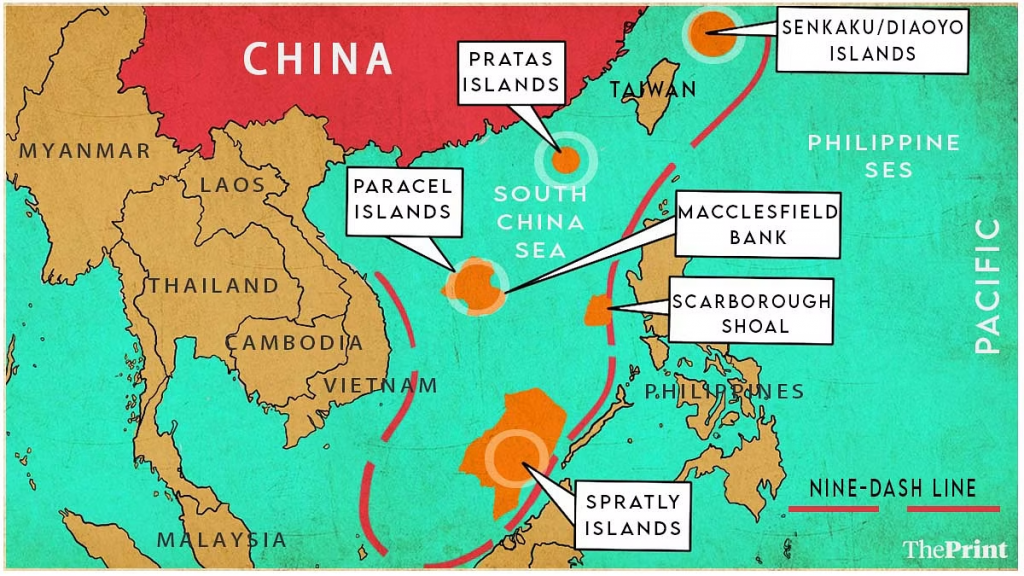
Dispute in South China Sea
- Southeast Asian countries like China, Vietnam, the Philippines, Brunei, Malaysia and Taiwan have had disputes over the contentious South China Sea region for centuries.
- The two primary points of contention are: The Spratly Islands and the Paracel Islands in the sea.
- Nine-dash line: China stakes claim to most of the region and at the heart of this claim is the U-shaped ‘nine-dash line’ that includes as much as 90 percent of these waters.
- This dotted line was adopted from Chinese maps in the 1940s, and represents Beijing’s claim over the sea and all the land features that are contained within the line.
2016 Arbitration Ruling
- In 2013, the Philippines initiated arbitration proceedings against China under the United Nations Convention on the Law of the Sea (UNCLOS) after a maritime dispute over the Scarborough Shoal in the South China Sea.
- A tribunal constituted under the Permanent Court of Arbitration (PCA), The Hague, delivered its verdict in July 2016.
- Key findings: China’s historic rights claims within the Nine-Dash Line have no legal basis under UNCLOS.
- Disputed features in the South China Sea do not generate extensive maritime zones.
- The ruling was declared final and legally binding under UNCLOS.
- China continues to reject the ruling, calling it “null and void” and refusing to recognise third-party arbitration.
Source: TH
Parrot Bornavirus 4
Syllabus: GS2/Health
Context
- Deadly bird virus PaBV-4 has been identified for the first time in India.
About
- Parrot Bornavirus 4 (PaBV-4) is a highly contagious virus that often causes rapid death in captive psittacine birds.
- Psittacine means relating to or resembling a parrot, describes the bird family Psittacidae and order Psittaciformes.
- It includes budgerigars, cockatiels, cockatoos, lovebirds, macaws, and parakeets.
- The virus is most commonly associated with Proventricular Dilatation Disease (PDD), a serious neurological and digestive disorder that affects a bird’s ability to process food.
- Infected birds may show symptoms such as weight loss, regurgitation, poor coordination, weakness and behavioural changes. In severe cases, the infection can prove fatal.
- It is not considered a zoonotic disease i.e. it does not naturally transmit from animals to humans.
Source: TH
Direct Seeded Rice (DSR)
Syllabus: GS3/Economy
In News
- Recently, the Chhattisgarh government issued an advisory to focus on prioritising Direct Seeded Rice (DSR) over the traditional transplanting method against the backdrop of the uncertainty of rainfall due to El Niño.
Direct Seeding of Rice
- It refers to the practice of sowing rice seeds directly onto the main field without using a nursery to transplant seedlings. It is also known as the ‘tar-wattar’ technique.
- It can be accomplished by sowing pre-germinated seed into wet soil (wet seeding via broadcast or drum seeder) or by planting dry seed (dry seeding by broadcast and seed-cum-fertilizer drill) on prepared ground.
Difference Between DSR and traditional method of transplantation
- In the traditional method of transplantation, paddy seeds are first grown in the nurseries for 25 to 35 days, then transplanted to the flooded fields.
- This method is water and labour intensive but generally improves crop health and yield.
- In Direct Seeded Rice (DSR) seeds are sown directly into the main field and no nursery is prepared and seedlings are transplanted.
- Sowing is done 20-30 days before the transplanting schedule.
- Fields are irrigated and laser-levelled before sowing. Seeds are treated with fungicide, soaked for 8 hours and dried for half a day for better germination and disease resistance.
- DSR requires first irrigation after 21 days of sowing and 14-17 irrigations at 7-10 days interval depending on soil and rainfall.
- Conversely, the conventional transplanting method requires 25–27 irrigations. Thus DSR is very water-efficient.
Benefits of DSR
- It can reduce water use by 15% to 20% (the traditional puddling method requires 3,600 to 4,125 litres of water to grow a single kilo of rice).
- It requires less labour and it matures 7 to 10 days faster, giving farmers more time to manage paddy straw.
- It offers low production cost and provides better soil physical conditions for following crops and less methane emission.
Challenges associated with DSR
- Weeds are the biggest significant impediment to the success of DSR.
- Weeds are more problematic in DSR than in puddled transplanting because sprouting weeds compete with simultaneously emerging DSR seedlings.
- Direct planting can help to reduce methane emissions, aerobic soil conditions can also increase nitrous oxide emissions.
- Nitrous oxide generation increases with redox potential.
- Micronutrient deficiencies are a prominent cause of concern in DSR such lack of iron content of the soil can severely impact yields and lead to major financial losses for farmers.
Source :TH
China’s Temporary Export Ban on Helium
Syllabus: GS3/ Science and Technology
Context
- The Ministry of Commerce and General Administration of Customs, China, has temporarily banned helium exports from the country.
About Helium
- Helium is an odorless, nontoxic, colorless, tasteless gas. It has a very low chemical reactivity and it is lighter than air.
- Helium exists as a gas except under extreme conditions. At temperatures near absolute zero, helium is a liquid.
- On Earth, Helium is a non-renewable natural resource that is mostly recovered from natural gas deposits.
- It is formed deep inside the Earth through the radioactive decay of uranium and thorium, which releases alpha particles that capture electrons to form helium atoms.
- The world’s major helium producers are the U.S. (43% of total supply), followed by Qatar, Russia, Canada, and Algeria.
How is Helium Obtained?
- Helium is extracted as a by-product of natural gas processing. Commercial extraction becomes viable only when helium concentration exceeds 0.3% by volume.
- It is separated from other gases based on its extremely low boiling point (-269°C).
- Commercial-grade helium generally requires 99.997% purity.
Applications
- Liquid helium is used to cool down magnets in MRI machines that doctors use to examine people for cancer and other diseases.
- A mixture of 80% Helium-20% Oxygen mixtures is used for deep sea diving.
- Helium is used in cardio-pulmonary resuscitation pumps during heart surgery
- Helium is critical in rare document preservation (like the Declaration of Independence of the United States).
- Helium is used as a leak detection agent for extremely small leaks since it won’t react with other gases due to its inert properties.
- Helium-Neon lasers are used in eye surgery.
Source: TH
Long March 10B Rocket
Syllabus: GS3/ Space
In News
- China successfully achieved its first reusable rocket landing at the Wenchang Commercial Space Launch Site, making a precise sea-based recovery after separation.
About Long March 10B
- The Long March 10B also written CZ-10B is a two-stage, medium-lift, partially reusable rocket built by the China Academy of Launch Vehicle Technology (CALT).
- It’s a commercial derivative of the Long March 10A, the variant China is developing for crewed lunar missions with the third stage and side boosters removed.
- It is 63 meters long, weighs about 760,000 kilograms at liftoff, and can carry up to 16,000 kg to low Earth orbit in reusable mode.
- The booster uses seven liquid oxygen–kerosene engines, while the upper stage runs on a liquid oxygen–methane engine.
Why it matters?
- China is now the second country to recover an orbital-class booster after propulsive descent — joining SpaceX and Blue Origin as reusable-rocket manufacturers, and becoming the first country outside the U.S. to pull this off.
- Reusable rockets can sharply lower launch costs, helping China deploy large satellite constellations and compete with Western broadband networks
Source: TH
Bureau of Port Security (BoPS)
Syllabus: GS3/Internal Security
Context
- The Union Home Minister reviewed the progress in the establishment of the Bureau of Port Security (BoPS).
About
- The Bureau of Port Security is being established as a statutory body under Section 13 of the Merchant Shipping Act, 2025.
- It is to be headed by a director general, the Bureau will function under the Ministry of Ports, Shipping and Waterways.
- The Bureau is being modelled on the lines of the Bureau of Civil Aviation Security (BCAS).
- Functions:
- It will be responsible for regulating and inspecting the security of ships and port facilities.
- The Bureau will also ensure the timely collection, analysis and sharing of security-related information, with a special focus on cybersecurity.
- A dedicated division will safeguard the IT infrastructure of ports against cyber threats.
- The Central Industrial Security Force (CISF) has been designated as a Recognised Security Organisation (RSO) for port facilities with responsibility for undertaking security assessments and preparation of security plans for ports.
Source: AIR
Next article
India-Australia Uranium Supplies Agreement
